
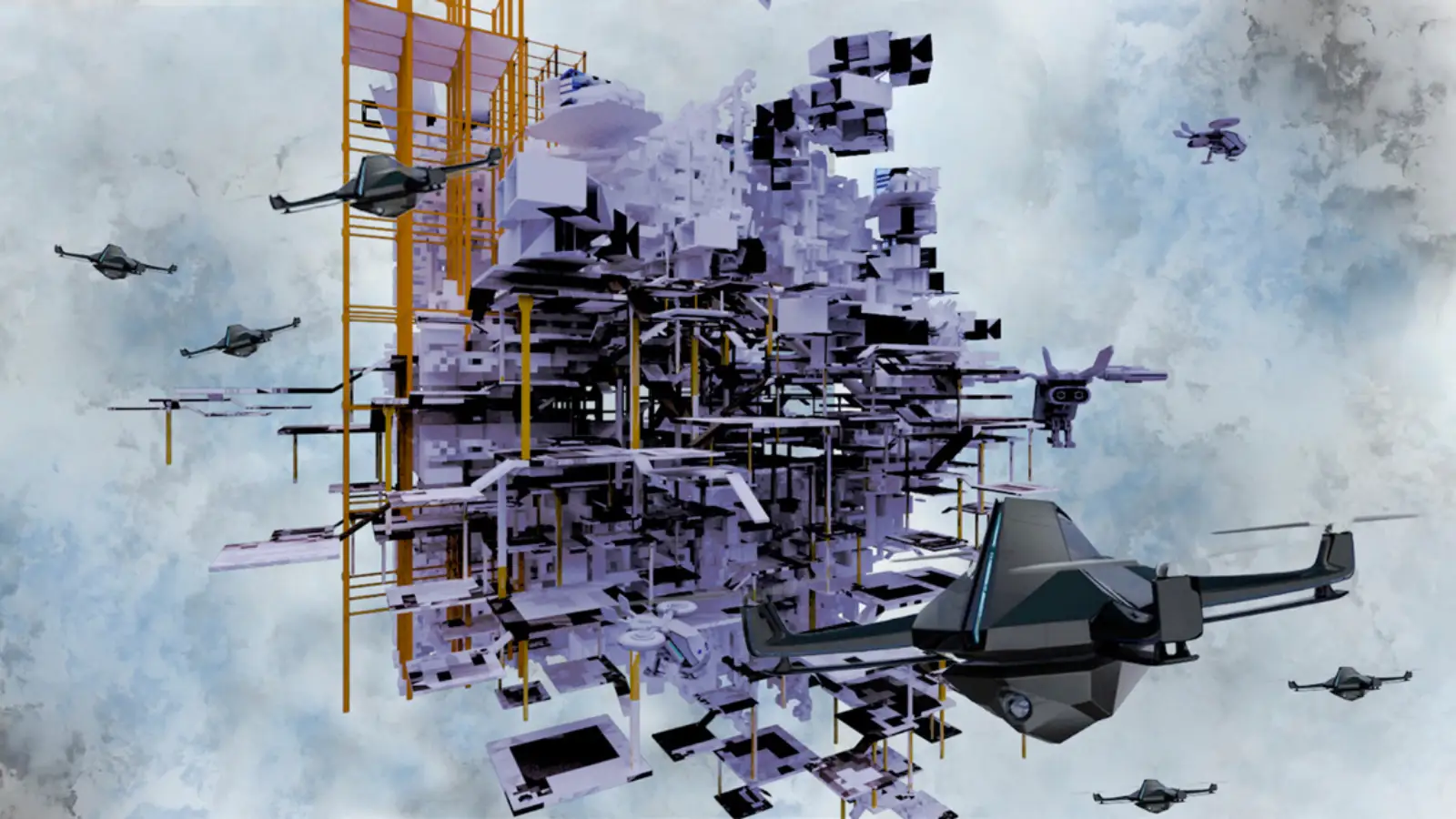
Synergistic Design Intelligence (SynDI) in Digital and Discrete Architecture

How to Cite
Keywords:
digital design, discrete architecture, synergistic design intelligence, hyperspace, human–computer interactionsAbstract
Architecture is undergoing a new digital turn prompted by the use of artificial intelligence, which has sparked both enthusiasm and concern—particularly regarding the notion that computers may replace architects. However, the repositioning of architects provides an opportunity to incorporate a new modus operandi with new forms of production. This paper proposes an alternative approach for human–computer interaction within the framework of discrete architecture – a topical production model for building components. The study relies on a collaborative and forward-thinking approach rather than artificiality, which often distances actors in the architecture field from emerging concepts, terminologies, and methods. It introduces the concept of synergistic design intelligence based on an improvised approach applied to a design studio experiment. The results signify a transition to a hyperspatial paradigm while demonstrating how heterogeneous computational strategies can enhance designers’ engagement with new concepts of computational thinking in architecture.
References
Almusaed, Amjad, and Ibrahim Yitmen. 2023. “Architectural Reply for Smart Building Design Concepts Based on Artificial Intelligence Simulation Models and Digital Twins.” Sustainability 15 (6): 4955. https://doi.org/10.3390/su15064955 DOI: https://doi.org/10.3390/su15064955
Bernstein, Phil. 2022. Machine Learning: Architecture in the Age of Artificial Intelligence. Routledge. DOI: https://doi.org/10.4324/9781003297192
Bhooshan, Shajay. 2017. “Parametric Design Thinking: A Case-Study of Practice-Embedded Architectural Research.” Design Studies 52 (September): 115–43. https://doi.org/10.1016/j.destud.2017.05.003 DOI: https://doi.org/10.1016/j.destud.2017.05.003
Bibri, Simon Elias, Jeffrey Huang, Senthil Kumar Jagatheesaperumal, and John Krogstie. 2024. “The Synergistic Interplay of Artificial Intelligence and Digital Twin in Environmentally Planning Sustainable Smart Cities: A Comprehensive Systematic Review.” Environmental Science and Ecotechnology 20 (July): 100433. https://doi.org/10.1016/j.ese.2024.100433 DOI: https://doi.org/10.1016/j.ese.2024.100433
Campo, Matias del. 2024. Diffusions in Architecture: Artificial Intelligence and Image Generators. Wiley. https://doi.org/10.1002/9781394191802 DOI: https://doi.org/10.1002/9781394191802
Carpo, Mario. 2013. The Digital Turn in Architecture 1992–2012. Wiley. https://doi.org/10.1002/9781118795811 DOI: https://doi.org/10.1002/9781118795811
Carpo, Mario. 2017. The Second Digital Turn: Design Beyond Intelligence. MIT Press. DOI: https://doi.org/10.7551/mitpress/9976.001.0001
Castro Pena, M. Luz, Adrián Carballal, Nereida Rodríguez-Fernández, Iria Santos, and Juan Romero. 2021. “Artificial Intelligence Applied to Conceptual Design. A Review of Its Use in Architecture.” Automation in Construction 124 (1): 103550. https://doi.org/10.1016/j.autcon.2021.103550 DOI: https://doi.org/10.1016/j.autcon.2021.103550
Chen, Wei, Mingyu Yu, and Jia Hou. 2024. “Synergistic Relationship, Agent Interaction, and Knowledge Coupling: Driving Innovation in Intelligent Construction Technology.” Buildings 14 (2): 542. https://doi.org/10.3390/buildings14020542 DOI: https://doi.org/10.3390/buildings14020542
Claypool, Mollie. 2020. “Architecture Goes Digital: The Discrete.” In The Architecture Machine: The Role of Computers in Architecture, edited by Teresa Fankhänel and Andres Lepik. Birkhäuser
Cross, Nigel. 2004. “Expertise in Design: An Overview.” Design Studies 25 (5): 427–41. https://doi.org/10.1016/j.destud.2004.06.002 DOI: https://doi.org/10.1016/j.destud.2004.06.002
Eastman, Charles M. 1972. “Adaptive-Conditional Architecture.” Paper presented at the Design Research Society’s Conference, Pittsburgh, PA.
Feng, Xingyue, Han Zhang, and Shaonong Wei. 2024. “Automation in Architectural Design: Optimization and Decision-Making in Interference Design.” Architectural Science Review 67 (5): 415–36. https://doi.org/10.1080/00038628.2024.2320096 DOI: https://doi.org/10.1080/00038628.2024.2320096
Fernández-Álvarez, Ángel. J., and Vicente López-Chao. 2023. “Drawing, Scripting, Prompting. A Critical Approach from Architectural Graphics.” Diségno (13): 143–52. https://doi.org/10.26375/disegno.13.2023.16
Friedman, Yona. 1972. “Information Processes for Participatory Design.” Paper presented at the Design Research Society’s Conference, Pittsburgh, PA.
Gero, John S., and Udo Kannengiesser. 2012. “Representational Affordances in Design, with Examples from Analogy Making and Optimization.” Research in Engineering Design 23 (3): 235–49. https://doi.org/10.1007/s00163-012-0128-y DOI: https://doi.org/10.1007/s00163-012-0128-y
Gero, John S., and Udo Kannengiesser. 2014. “The Function-Behaviour-Structure Ontology of Design.” In An Anthology of Theories and Models of Design, edited by Amaresh Chakrabarti and Lucienne T. M. Blessing. Springer. https://doi.org/10.1007/978-1-4471-6338-1_13 DOI: https://doi.org/10.1007/978-1-4471-6338-1_13
Hageman, B. (n.d.). “Wasp++.” Accessed August 8, 2024. https://www.food4rhino.com/en/app/wasp-0
Haidar, Adonis, Jason Underwood, and Paul Coates. 2019. “Smart Processes for Smart Buildings: ‘Sustainable processes’, ‘Recyclable processes’ and ‘Building seeds’ in parametric design.” Architectural Engineering and Design Management 15 (5): 402–29. https://doi.org/10.1080/17452007.2018.1564645 DOI: https://doi.org/10.1080/17452007.2018.1564645
Haken, Hermann. 1987. “Synergetics: An Approach to Self-Organization.” In Self-Organizing Systems: The Emergence of Order, edited by F. Eugene Yates, Alan Garfinkel, Donald O. Walter, and Gregory B. Yates. Springer. https://doi.org/10.1007/978-1-4613-0883-6_22 DOI: https://doi.org/10.1007/978-1-4613-0883-6_22
Haslop, Blaire, Marc Aurel Schnabel, and Serdar Aydin, 2017. “Digital Decay.” International Journal of Parallel, Emergent and Distributed Systems (32): S82–S88. https://doi.org/10.1080/17445760.2017.1390092 DOI: https://doi.org/10.1080/17445760.2017.1390092
Huang, Lee-Su and Spaw, Gregory. 2023. “Augmented Reality Assisted Robotics: Tube Bending.” Paper presented at the 43rd Annual Conference for the Association for Computer Aided Design in Architecture (ACADIA), Denver, CO. https://papers.cumincad.org/cgi-bin/works/paper/acadia23_v2_340 DOI: https://doi.org/10.52842/conf.acadia.2023.2.340
Jahn, Gwyllim, Cameron Newnham, and Nick van den Berg. 2022. “Augmented Reality for Construction from Steam Bent Timber.” Paper presented at the 27th CAADRIA Conference, Sydney. https://doi.org/10.52842/conf.caadria.2022.2.191 DOI: https://doi.org/10.52842/conf.caadria.2022.2.191
Johns, Ryan Luke. 2017. “Augmented Materiality: Modelling with Material Indeterminacy.” In Fabricate 2014: Negotiating Design & Making , edited by Fabio Gramazio, Matthias Kohler, and Silke Langenberg. UCL Press. https://doi.org/10.2307/j.ctt1tp3c5w.30 DOI: https://doi.org/10.2307/j.ctt1tp3c5w.30
Jordanous, Anna. 2016. “Four PPPPerspectives on Computational Creativity in Theory and in Practice.” Connection Science 28 (2): 194–216. https://doi.org/10.1080/09540091.2016.1151860 DOI: https://doi.org/10.1080/09540091.2016.1151860
Kannengiesser, Udo, and John S. Gero. 2019. “Design Thinking, Fast and Slow: A Framework for Kahneman’s Dual-System Theory in Design.” Design Science 5 (1): e10. https://doi.org/10.1017/dsj.2019.9 DOI: https://doi.org/10.1017/dsj.2019.9
Leach, Neil. 2022. Architecture in the Age of Artificial Intelligence: An Introduction to AI for Architects . Bloomsbury. DOI: https://doi.org/10.5040/9781350165557
Lin, Han-Ting, and June-Hao Hou. 2022. “Exploring the Topological System of Dougong.” Paper presented at the International Conference on Computer-Aided Architectural Design Research in Asia (CAADRIA), Sydney. https://doi.org/10.52842/conf.caadria.2022.1.667 DOI: https://doi.org/10.52842/conf.caadria.2022.1.667
Lynn, Greg. 1999. Animate Form . Princeton Architectural Press.
Qian, Lena, and John S Gero. 1996. “Function–Behavior–Structure Paths and their Role in Analogy-Based Design.” Artificial Intelligence for Engineering Design, Analysis and Manufacturing 10 (4): 289–312. http://dx.doi.org/10.1017/S0890060400001633 DOI: https://doi.org/10.1017/S0890060400001633
Ploennigs, Joern, and Markus Berger. “Ai Art in Architecture.” AI in Civil Engineering 2, no. 8 (2023). https://doi.org/10.1007/s43503-023-00018-y DOI: https://doi.org/10.1007/s43503-023-00018-y
Retsin, Gilles. Discrete: Reappraising the Digital in Architecture. Wiley , 2019. Rossi, A. (n.d.). “Wasp – A Combinatorial Toolkit for Discrete Design.” Accessed August 8, 2024. https://www.food4rhino.com/en/app/wasp
Rossi, A., and Tessmann, O. 2017. “Geometry as Assembly – Integrating Design and Fabrication with Discrete Modular Units.” Paper presented at the 35th International Conference on Education and Research in Computer Aided Architectural Design in Europe (eCAADe), Rome. https://doi.org/10.52842/conf.ecaade.2017.2.201 DOI: https://doi.org/10.52842/conf.ecaade.2017.2.201
Schumacher, Patrik. 2008. “Parametricism as style – Parametricist manifesto.” Patrik Schumacher’s Online Blog. Accessed on August 8, 2024. https://patrikschumacher.com/parametricism-as-style-parametricist-manifesto/
Sterk, Tristan. 2006. “Responsive Architecture: User-Centered Interactions within the Hybridized Model of Control.” In The Architecture Co-Laboratory: Game, Set and Match II. On Computer Games, Advanced Geometries, and Digital Technologies , edited by Kas Oosterhuis, and Lukas Feireiss. Episode Publishers.
Tamke, Martin, Paul Nicholas, and Mateusz Zwierzycki. 2018. “Machine Learning for Architectural Design: Practices and Infrastructure.” International Journal of Architectural Computing 16 (2): 123–43. https://doi.org/10.1177/1478077118778580 DOI: https://doi.org/10.1177/1478077118778580
Terzidis, Kostas. 2003. Expressive Form: A Conceptual Approach to Computational Design. Routledge. DOI: https://doi.org/10.4324/9780203586891
Yu, Boyuan, and Lei Zhang. 2021. “A Virtual Model Generation Based on Grasshopper-Wasp.” Paper presented at the 2nd International Conference on Intelligent Design (ICID), Xi’an. https://doi.org/10.1109/ICID54526.2021.00052 DOI: https://doi.org/10.1109/ICID54526.2021.00052


