


How to Cite
Keywords:
rural women, crime prevention, social support, speech emotion recognitionAbstract
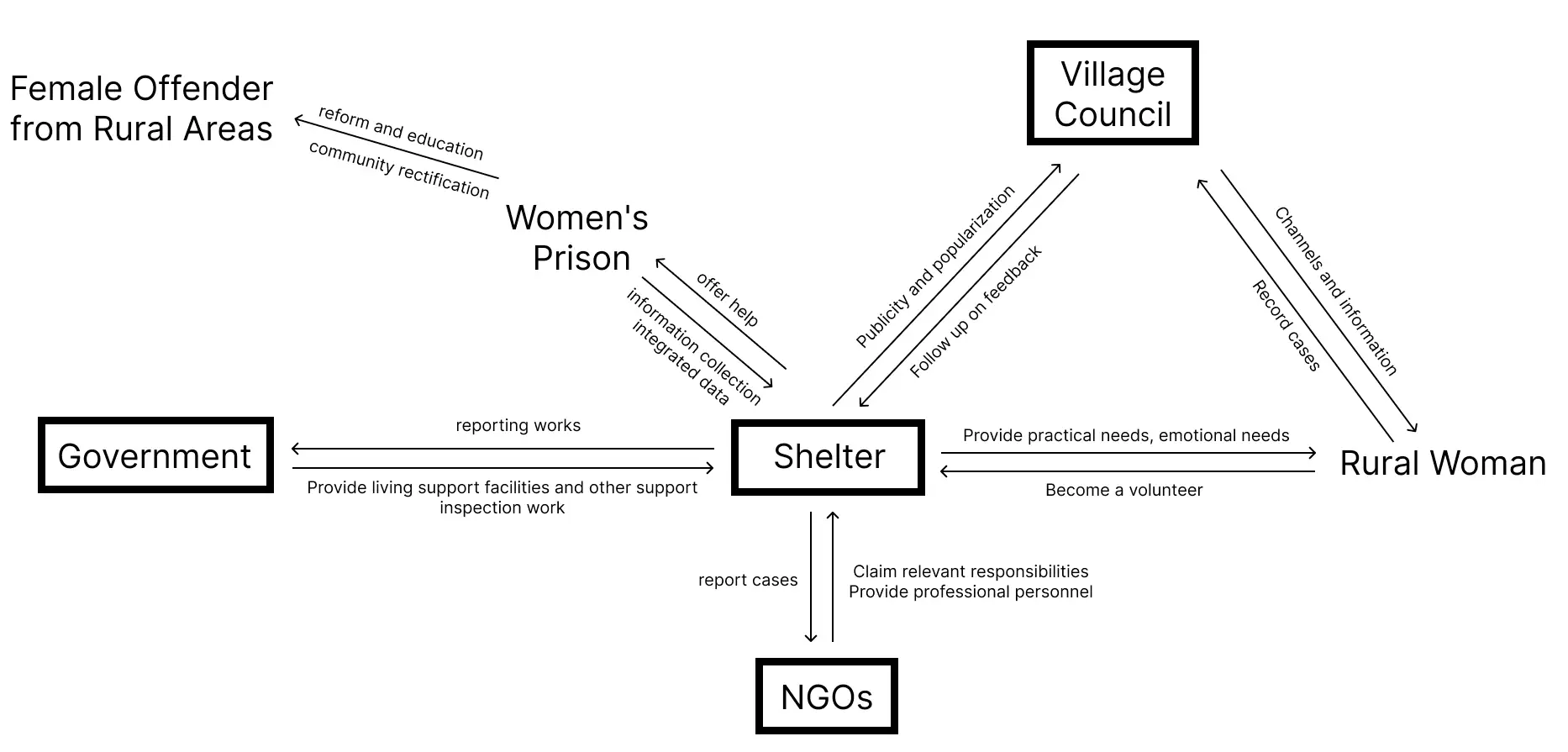
Currently, most crime prevention efforts focus on social services, such as behaviour correction and resocialisation, with limited emphasis on the role of social support systems for rural women. Although the proportion of crimes committed by women is not significantly high, such crimes inflict deep harm on families and society. This paper aims to design and study an intelligent shelter system for rural women to address their support needs in the face of family and social problems and to indirectly prevent the occurrence of crime. Based on case studies of rural women offenders and an analysis of existing shelters, this research employs stakeholder mapping, user journey mapping and service blueprints to examine interaction dynamics. In addition, the addition of speech emotion recognition technology facilitates long-term support and crime prevention strategies. This approach enables the organic integration of resources and network connectivity for the prevention of crime by rural women and provides immediate guidance to them.
References
Abid, Amna, and Suleman Shahid. 2017. “Helping Pregnant Women in the Rural Areas of Pakistan Using a Low-Cost Interactive System.” ICTD 17 42: 1–5. DOI: https://doi.org/10.1145/3136560.3136607
Ahmed, Mohsin Y., Zeya Chen, Emma Fass, and John Stankovic. 2017. “Real Time Distant Speech Emotion Recognition in Indoor Environments.” MobiQuitous 2017 215–24. DOI: https://doi.org/10.1145/3144457.3144503
Bardzell, Shaowen. 2010. “Feminist HCI: Taking Stock and Outlining an Agenda for Design.” CHI 10 1301–10. DOI: https://doi.org/10.1145/1753326.1753521
Bosse, Tibor, and Charlotte Gerritsen. 2010. “An Agent-Based Framework to Support Crime Prevention.” AAMAS 10 1: 525–32. DOI: https://doi.org/10.65109/XMKP5055
Callan, F. D., and E. M. Dolan. 2013. “Parenting Constraints and Supports of Young Low-Income Mothers in Rural United States.” Journal of Comparative Family Studies 44 (2): 157–74. DOI: https://doi.org/10.3138/jcfs.44.2.157
Chen, Jue. 2024. “Study on Corrective Measures to Prevent Female Offenders from Re-Offending” (in Chinese). Research on Crime and Reform 5: 62–68.
Coleman, Rebecca, Louise Almond, and Michelle McManus. 2017. “Do Female Offenders Differ? Comparing the Criminal Histories of Serious Violent Perpetrators with a Control Sample.” Journal of Investigative Psychology and Offender Profiling 15 (1): 3–19. DOI: https://doi.org/10.1002/jip.1485
Coward, R. T., L. A. Davis, C. H. Gold, H. Smiciklas-Wright, L. E. Thorndyke, and F. W. Vondracek. 2006. Rural Women’s Health: Linking Mental, Behavioral, and Physical Health . Springer Publishing Company, Inc.
Deng, Jun, Xinzhou Xu, Zixing Zhang, Sascha Fruhholz, and Bjorn Schuller. 2018. “Semisupervised Autoencoders for Speech Emotion Recognition.” IEEE/ACM 26 1: 31–43. DOI: https://doi.org/10.1109/TASLP.2017.2759338
Erete, Sheena Lewis. 2012. “Crime Prevention Technologies in Low-Income Communities.” XRDS 19 2: 24–26. DOI: https://doi.org/10.1145/2382856.2382867
Erete, Sheena Lewis. 2012. “Examining and Designing Community Crime Prevention Technology.” CHI EA 12 939-942. DOI: https://doi.org/10.1145/2212776.2212870
Erete, Sheena L., Ryan Miller, and Dan A. Lewis. 2014. “Differences in Technology Use to Support Community Crime Prevention.” CSCW Companion 14 153–56. DOI: https://doi.org/10.1145/2556420.2556499
Geller, James, Angela Garretsen, and Soon Ae Chun. 2024. “Continuous Evaluation for a Multi-Dimensional Violent Crime Prevention and Recovery Policy.” dg. O 24 1030–33. DOI: https://doi.org/10.1145/3657054.3659121
Hauenstein, E. J., and S. Peddada. 2007. “Prevalence of Major Depressive Episodes in Rural Women Using Primary Care.” Journal of Health Care for the Poor and Underserved 18 (1): 185–202. DOI: https://doi.org/10.1353/hpu.2007.0010
Henderson Hurley, Martha. 2019. “Female Offenders and Violent Crime.” In The Encyclopedia of Women and Crime. Edited by Nicole Hahn Rafter. New York: Checkmark Books. DOI: https://doi.org/10.1002/9781118929803.ewac0143
Huang, Zhengwei, Ming Dong, Qirong Mao, and Yongzhao Zhan. 2014. “Speech Emotion Recognition Using CNN.” MM 14 801–04. Jordán Conde, Zayira, William Eric Marsh, Andrew W. Luse, and DOI: https://doi.org/10.1145/2647868.2654984
Li-Shan Eva Tao. 2008. "GuardDV: A Proximity Detection Device for Homeless Survivors of Domestic Violence.” CHI EA 8 3855–60. DOI: https://doi.org/10.1145/1358628.1358943
Kadar, Cristina, and Irena Pletikosa Cvijikj. 2014. “CityWatch: The Personalized Crime Prevention Assistant.” MUM 14 260–261. DOI: https://doi.org/10.1145/2677972.2678008
Li, Hongyan. 2023.” Research on Crime Prevention and Control Based on Big Data Method.” ICBDT 23 146–50. DOI: https://doi.org/10.1145/3627377.3627400
Liu, Dan. 2007. “Violent Crime Committed by Females from the Perspective of Criminal Sociology – Research on the Point of View of Our Country” (In Chinese). Jilin University.
Liu, Zhengqiang. 2022. “‘She’ Crime: Understanding the Gendered Rhetoric of Female Violence” (in Chinese). Chinese Prison Journal 37 (5): 25–30.
Office of the Leading Group for the Seventh National Population Census of The State Council. 2021. “Major Figures on 2020
Population Census of China” (in Chinese). Beijing: China Statistics Press . PDF. https://www.stats.gov.cn/sj/pcsj/rkpc/d7c/202303/P020230301403217959330.pdf
Parmar, Vikram, Gert Groeneveld, Ashis Jalote-Parmar, and David Keyson. 2009. “Tangible User Interface for Increasing Social Interaction among Rural Women. TEI 9 139–45. DOI: https://doi.org/10.1145/1517664.1517699
Pérez Vizcarra, Aldo Alexis, Guadalupe Paulina Anccasi Figueroa, Jaison Willian Torres Chana, and Francisco José García-Peñalvo. 2019. “An App Based on Cooperative Learning for the Detection of Danger Points and the Prevention of Risk Areas in a City.” TEEM 19 830–37. DOI: https://doi.org/10.1145/3362789.3362929
Pletikosa Cvijikj, Irena, Cristina Kadar, Bogdan Ivan, and Yiea-Funk Te. 2015. “Towards a Crowdsourcing Approach for Crime Prevention.” UbiComp/ISWC 15: 1367–72. DOI: https://doi.org/10.1145/2800835.2800971
Qin, Yigang, Weilun Duan, Qunfang Wu, and Zhicong Lu. 2024. “Dismantling Gender Blindness in Online Discussion of a Crime/Gender Dichotomy.” Proceedings of the ACM on Human–Computer Interaction8, CSSW1 195: 1–31. DOI: https://doi.org/10.1145/3653686
Steffensmeier, Darrell, and Emilie Allan. 1996. “Gender and Crime: Toward a Gendered Theory of Female Offending.” Annual Review of Sociology 22: 459–487. DOI: https://doi.org/10.1146/annurev.soc.22.1.459
Steffensmeier, Darrell, Emilie Allan, and Cathy Streifel. 1989. “Development and Female Crime: A Cross-National Test of Alternative Explanations.” Social Forces 68 (1): 262–83. DOI: https://doi.org/10.2307/2579228
Shawket Rupok, Quazi Sunjida, and Abdullahi Chowdhury. 2018. “Using E-Learning to Engage Unemployed Rural Women in Aquaculture in Bangladesh to Reduce Poverty.” DATA 18 41: 1–6. DOI: https://doi.org/10.1145/3279996.3280037
Sultana, Sharifa, François Guimbretière, Phoebe Sengers, and Nicola Dell. 2018. “Design within a Patriarchal Society: Opportunities and Challenges in Designing for Rural Women in Bangladesh.” CHI 18 536: 1–13. DOI: https://doi.org/10.1145/3173574.3174110
Xiang, Qingping. 2019. “An Insight into Rural Women’s Understanding and Handling of Disputes” (in Chinese). Democracy and Law Times, August 1.
Willging, Cathleen E., Ethel G. Nicdao, Elise M. Trott, and Nicole C. Kellett. 2015. “Structural Inequality and Social Support for Women Prisoners Released to Rural Communities.” Women & Criminal Justice 26 (2): 145–64. DOI: https://doi.org/10.1080/08974454.2015.1067174
Zhang, Dandan, Lixing Li, and Chen Tong. 2018. “Minimum Wage, Rural Migrants, Unemployment, and Crime” (in Chinese). China Economic Querterly 17, no. 3 (2018): 1035-1054.
Zhang, Haipeng, and Kun Chen. 2016. “Labor Out-migration and Rural Crime: Evidence from China’s Village-Level Panel Data” (in Chinese). Labor Economic Research 4 (2016): 98–118.
Zhang, Yuan, Shijing Liu, and Liang Liu. 2011. “Urban–Rural Income Gap, Migrant Unemployment and the Rise in Crime in China” (in Chinese). Economic Research Journal 2(2011): 59–72.


