
Three Creative Methods for High-Rise Building Design

Authors

Downloads

DOI:

10.31182/cubic.2025.8.81

Keywords:

structuralism, symbolic translation, bionics, spatial interest, sustainable architecture

Abstract

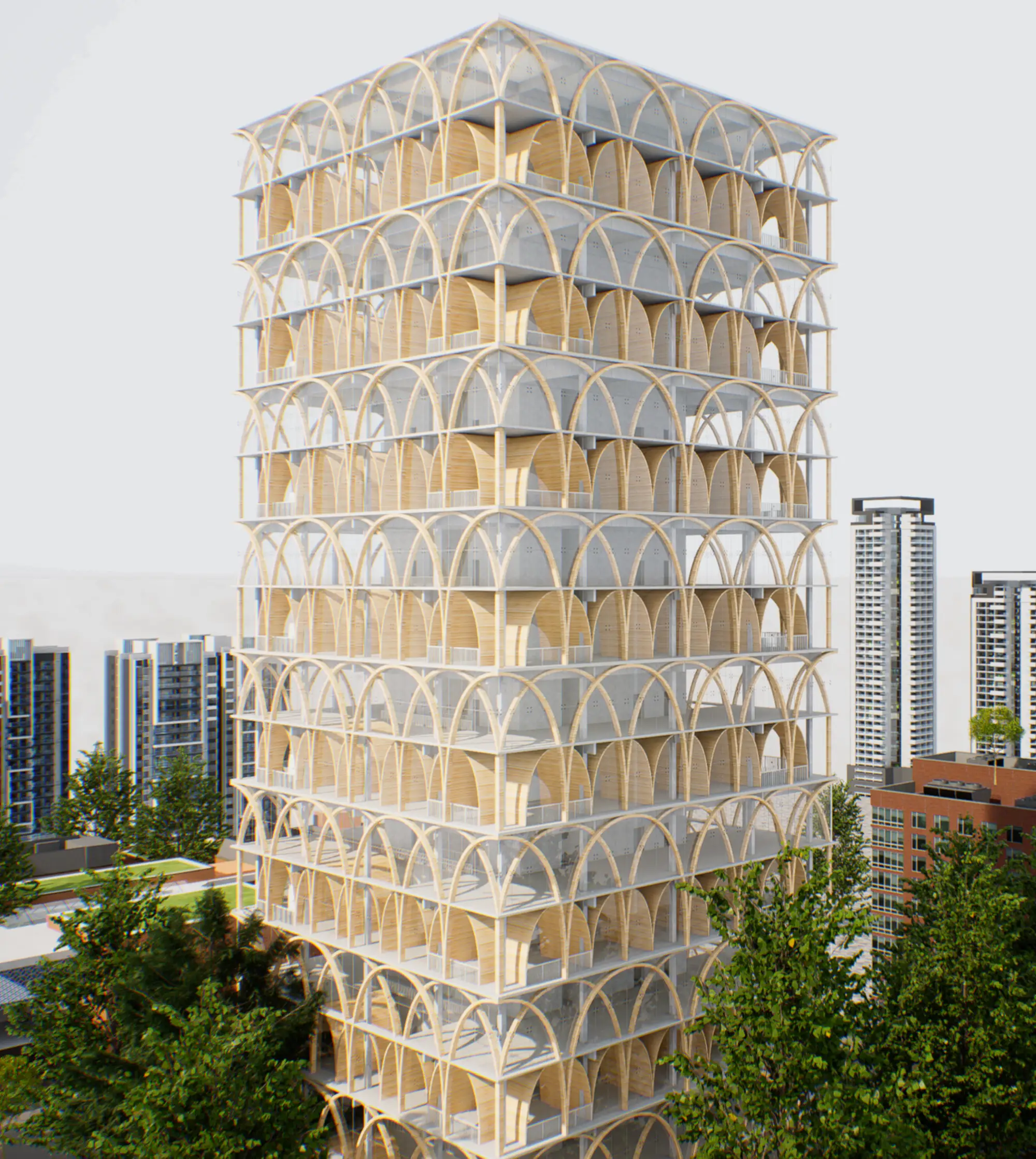
This paper explores three innovative high-rise building design concepts to enrich urban environments by enhancing human perception, integrating cultural heritage and promoting sustainability. Runxin Fu’s ‘The Perceptual Condenser’ disrupts typical spatial experiences through composite wall systems and angled shear walls, encouraging active exploration and improving the human experience in vertical environments through Structuralism. Shiyao Feng’s ‘The Landscape City’ integrates elements of traditional Chinese shanshui gardens and paintings, using masking techniques and spatial contrasts to create a distinctive and culturally enriched spatial experience. Biaoqing Tao’s ‘Arching’ concept employs biomimetic modular methods, emphasising sustainability and reducing carbon emissions through the use of wood and modular construction. These approaches propose a transformative vision for high-rise buildings that aims to break free from homogenised urban architecture and foster diverse, sustainable and culturally rich urban spaces.

How to Cite

Deng, X., Fu, R., Feng, S., & Tao, B. (2025). Three Creative Methods for High-Rise Building Design. Cubic Journal, 8(8), 75–90. https://doi.org/10.31182/cubic.2025.8.81

Published

2025-12-01

Author Biographies

Xi Deng, University of Hong Kong

Xi Deng is a research fellow in the Faculty of Architecture at the University of Hong Kong. Receiving his PhD in Architecture from Cardiff University, he has taught design studios for BA and MA students as a faculty lecturer (now an assistant professor) at Harbin Institute of Technology, where he also worked as the assistant chair of the Department of Architecture. Deng holds an MSc in Building Engineering/Architecture from Politecnico di Milano and a BEng in Civil Engineering from Chongqing University. He has rich experience in interdisciplinary research and design practice in the construction industry. His research interests include environmental design, low-carbon design, architectural design of large-scale buildings, aesthetics of building structures and digital fabrication.

Runxin Fu, Laguarda.Low Architects

Runxin Fu is an architect working at Laguarda.Low Architects, based in the US. Before completing an MSc in Advanced Architectural Design at Columbia University in 2023, he earned a graduate degree in architecture from Harbin Institute of Technology, China, in 2022. His innovative concept of ‘Campus TOD’ contributed to his team’s first-place victory in the China National Undergraduate Sustainable Architecture Design Competition. His master’s degree thesis on audiovisual educational technology garnered the prestigious Columbia GSAPP Writing Prize and widespread acclaim. His interests include spatial design, neuroscience and 3D printing.

Shiyao Feng

Shiyao Feng, an architect and postgraduate student in architecture and planning, graduated from the School of Architecture and Design at Harbin Institute of Technology, China, in 2024. She pays close attention to details in life and believes that ‘architecture is a form of social art’. She will always love the beauty of all forms in architectural spaces.

Biaoqing Tao

Biaoqing Tao, an architect and PhD candidate in digital architecture, graduated from the School of Architecture and Design at Harbin Institute of Technology, China, in 2024. He explores the possibilities of different materials and structures for shaping space and pays attention to the commonality and uniqueness of architectural forms and the environment, committed to creating comfortable and beautiful living spaces.

References

Berkeley, G. 1709. An Essay Towards a New Theory of Vision. Aaron Rhames.

Dong, Q. C. 2012. Rongtai Collection (Part 1). Xiling Seal Engravers Press.

Duan, Z., Q. Huang, and Q. Zhang. 2022. “Life Cycle Assessment of Mass Timber Construction: A Review.” Building and Environment 221: 109320. DOI: https://doi.org/10.1016/j.buildenv.2022.109320

Li, F. G. 2020. “Study on the Aesthetic Thought of Chinese Landscape Painting in the Philosophy of Confucianism, Taoism and Buddhism.” In The Proceedings of the 2020 2nd International Conference on Humanities, Cultures, Arts and Design. Francis Academic Press. https://doi.org.10.25236/ICHCAD.2020.131.

Li, X. J., W. J. Xie, L. Xu, L. L. Li, C. Y. Jim, and T. B. Wei. 2022. “Holistic Life-Cycle Accounting of Carbon Emissions of Prefabricated Buildings Using LCA and BIM.” Energy and Buildings 266: 112136. DOI: https://doi.org/10.1016/j.enbuild.2022.112136

Pallasmaa, J. 2012. The Eyes of the Skin: Architecture and the Senses. 3rd ed. John Wiley & Sons.

Qi, F. 2024. “Viewing the Characteristics of Chinese Landscape Painting from Guo Xi’s ‘San Yuan Method.’” International Journal of Arts and Humanities Studies 1: 19–22. DOI: https://doi.org/10.32996/Ijahs.2024.4.1.4

Tao, Y. M. 2008. Tao Yuan Ming Collection. Sanjin Publishing House.

Tong, J. 1984. Jiangnan Garden Chronicles (in Chinese). 2nd ed. China Architecture & Building Press.