

How to Cite
Keywords:
urban villages, urban regeneration, sustainable redevelopment, immersive technologyAbstract
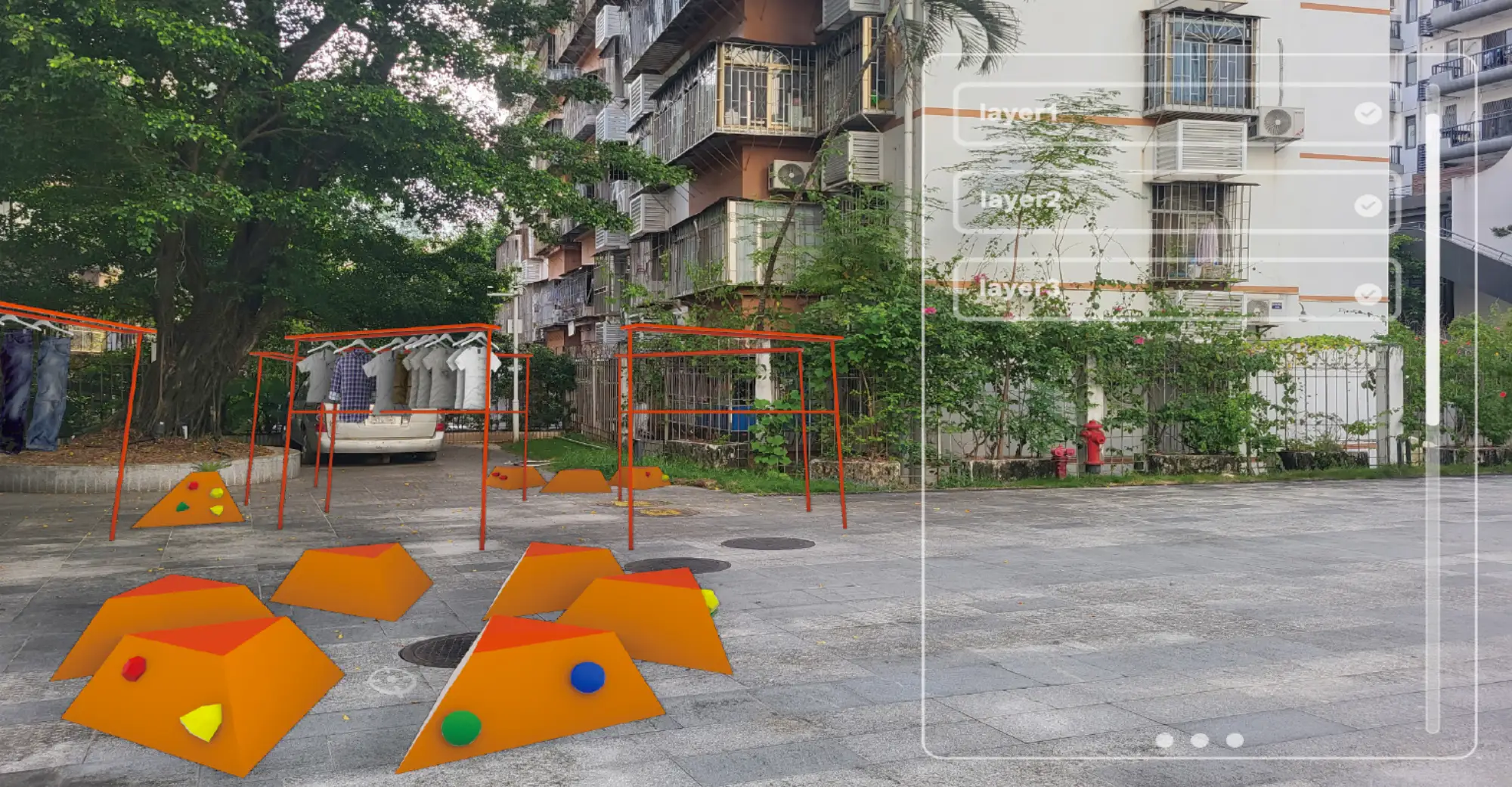
Rapid urbanisation in China has led to urban villages, presenting challenges in spatial governance and renewal. Advanced digital and parametric methodologies can extend beyond traditional building-focused strategies to address public space vitality and resident demand issues. However, their effectiveness in capturing and responding to intricate spaces and individual needs within urban villages remains underexplored. This study investigates how mixed reality (MR) in experiential design systems can revitalise urban villages. We review existing literature and design projects using digital tools in the survey, analysis, and design phases of urban village regeneration. We then propose a design framework that leverages immersive technology to revitalise public spaces. Using Shenzhen’s Baishizhou as a case site, the research focuses on four types of highly utilised public spaces from the perspective of migrant renters. Integrating MR technology, this multi-port framework effectively bridges the gap inherent in existing digital tools, thereby enhancing designer productivity.
References
Abdelhameed, W. Y. K. 2009. “Urban Wiki: An Online Urban Design System.” In SIGraDi 2009 – Proceedings of the 13th Congress of the Iberoamerican Society of Digital Graphics (Sao Paulo, Brazil, November 16–18, 2009). CUMINCAD.
Avella, F., and F. Schilleci. 2020. “Virtual Reality for Urban Planning. The Port of Palermo: Past, Present, Future.” SCIRES-IT-SCIentific RESearch and Information Technology 10 (2).
Banfi, F., R. Brumana, and C. Stanga. 2019. “Extended Reality and Informative Models for the Architectural Heritage: From Scan-to-BIM Process to Virtual and Augmented Reality.” Virtual Archaeology Review 10 (21). DOI: https://doi.org/10.4995/var.2019.11923
Banfi, F., M. Previtali, C. Stanga, and R. Brumana. 2019. “A Layered-Web Interface Based on HBIM and 360 Panoramas for Historical, Material and Geometric Analysis.” The International Archives of the Photogrammetry, Remote Sensing and Spatial Information Sciences 42 (2). DOI: https://doi.org/10.5194/isprs-archives-XLII-2-W9-73-2019
Behrouz, T. 2024. “D-ARE: A Location-Based Augmented Reality Tool for Public Engagement in Design of Built Environment.” In Accelerated Design – Proceedings of the 29th CAADRIA Conference (Singapore, April 20–26, 2024), edited by Nicole Gardner, Christiane M. Herr, Likai Wang, Hirano Toshiki, and Sumbul Ahmad Khan, CUMINCAD.
Ben-Joseph, E., H. Ishii, J. Underkoffler, B. Piper, and L. Yeung. 2001. “Urban Simulation and the Luminous Planning Table: Bridging the Gap between the Digital and the Tangible.” Journal of Planning Education and Research 21 (2). DOI: https://doi.org/10.1177/0739456X0102100207
Broll, W., M. Stoerring, and C. Mottram. 2003. “The Augmented Round Table – A New Interface to Urban Planning and Architectural Design.” In INTERACT .
Cummings, J. J., and J. N. Bailenson. 2016. “How Immersive Is Enough? A Meta-Analysis of the Effect of Immersive Technology on User Presence.” Media Psychology 19 (2). DOI: https://doi.org/10.1080/15213269.2015.1015740
Foth, M., G. Caldwell, J. Fredericks, and K. Volz. 2018. “Augmenting Cities beyond Bedazzlement: Empowering Local Communities Through Immersive Urban Technologies.” In Workshop Proceedings of Augmenting Cities and Architecture with Immersive Technologies, Media Architecture Biennale (MAB-18) . Media Architecture Biennale.
Gao, Y., S. Shahab, and N. Ahmadpoor. 2020. “Morphology of Urban Villages in China: A Case Study of Dayuan Village in Guangzhou.” Urban Science 4 (2). DOI: https://doi.org/10.3390/urbansci4020023
Gebrian, M., M. Florián, and S. Eloy. 2021. “Designing the Bodily Metaverse of Lisbon.” In Virtual Aesthetics in Architecture. Routledge. DOI: https://doi.org/10.4324/9781003183105-21
Gordon, E., and E. Manosevitch. 2011. “Augmented Deliberation: Merging Physical and Virtual Interaction to Engage Communities in Urban Planning.” New Media and Society 13 (1). DOI: https://doi.org/10.1177/1461444810365315
Hajrasouliha, A. H. 2024. “Applications, Approaches, and Ethics of the Extended Reality in Urban Design and Planning.” Journal of the American Planning Association 90 (3). DOI: https://doi.org/10.1080/01944363.2023.2275123
Hao, P., S. Geertman, P. Hooimeijer, and R. Sliuzas. 2012. “The Land-Use Diversity in Urban Villages in Shenzhen.” Environment and Planning A 44. DOI: https://doi.org/10.1068/a44696
Krueger, M. W. 1977. “Responsive Environments.” In Proceedings of the National Computer Conference (June 13–16, 1977). Association for Computing Machinery. DOI: https://doi.org/10.1145/1499402.1499476
Lee, G. A., A. Dünser, S. Kim, and M. Billinghurst. 2012. “CityViewAR: A Mobile Outdoor AR Application for City Visualization.” In 2012 IEEE International Symposium on Mixed and Augmented Reality – Arts, Media, and Humanities (ISMAR-AMH). IEEE. DOI: https://doi.org/10.1109/ISMAR-AMH.2012.6483989
Lee, Y., K. Masai, K. Kunze, M. Sugimoto, and M. Billinghurst. 2016. “A Remote Collaboration System with Empathy Glasses.” In 2016 IEEE International Symposium on Mixed and Augmented Reality (ISMAR – Adjunct). IEEE. DOI: https://doi.org/10.1109/ISMAR-Adjunct.2016.0112
Lian, R., and Y. Hu. 2020. "The Complexity in Modern Architecture and Self-growing Vitality of Villages-in-the-City: From Urban Resilience Theory to Parametric Design Practice". China Architectural Education 1.
Ling, X., and S. Yang. 2023. "A Micro-Renovation Experiment Based on Qinghu Village in Longhua, Shenzhen". World Architectural Review 38 (4).
Liu, R., and T. C. Wong. 2018. “Urban Village Redevelopment in Beijing: The State-Dominated Formalization of Informal Housing.” Cities 72. DOI: https://doi.org/10.1016/j.cities.2017.08.008
Liu, Y., S. Geertman, F. van Oort, and Y. Lin. 2018. “Making the ‘Invisible’ Visible: Redevelopment-Induced Displacement of Migrants in Shenzhen, China.” International Journal of Urban and Regional Research 42. DOI: https://doi.org/10.1111/1468-2427.12646
Liu, Y., S. He, F. Wu, and C. Webster. 2010. “Urban Villages Under China’s Rapid Urbanization: Unregulated Assets and Transitional Neighbourhoods.” Habitat International 34. DOI: https://doi.org/10.1016/j.habitatint.2009.08.003
Llabres, E., and E. Rico. 2016. “Relational Urban Models: Parameters, Values and Tacit Forms of Algorithms.” Architectural Design 86. DOI: https://doi.org/10.1002/ad.2028
Moine, L. 2017. “Immersion Creating Engagement in Urban Planning and Redesign.” In 2017 23rd International Conference on Virtual System & Multimedia (VSMM). IEEE. DOI: https://doi.org/10.1109/VSMM.2017.8346292
Parker, C., S. Yoo, W. Jenek, and Y. Lee. 2021. “Preface: Augmenting Space: The Role of Immersive Technologies in Future Cities.” Interaction Design and Architecture 48. DOI: https://doi.org/10.55612/s-5002-048-001psi
Romo, A. 2021. “AR Challenge and Exhibition Report: Long Beach, California.” https://www.longbeach.gov/globalassets/smart-city/media-library/documents/ar-challenge-exhibition-report-2021_final. Long Beach Press.
Stals, A., and L. Caldas. 2022. “State of XR Research in Architecture with Focus on Professional Practice – A Systematic Literature Review.” Architectural Science Review 65. DOI: https://doi.org/10.1080/00038628.2020.1838258
Tran, N. a. Q. 2019. “Exchange Information Enhancement in Execution Method by Using Virtual Reality.” The International Archives of the Photogrammetry, Remote Sensing and Spatial Information Sciences XLII-5-W2. DOI: https://doi.org/10.5194/isprs-archives-XLII-5-W2-71-2019
Xia, Z., and Y. Song. 2015. "Study on the Space and Environment of Retained Urban Villages from the Perspective of Daily Life: The Empirical Analysis of Three Retained Urban Villages in Changzhou". Modern Urban Research 2015 (10).
Xu, F., and L. Wang. 2014. "Capillarity Phenomenon and the Renewal of Urban Villages: Research on the Parametric Design During the Reconstruction of Beijing Old City". Journal of Human Settlements in West China 29 (6).
Zhang, C., W. Zeng, and L. Liu. 2021. “UrbanVR: An Immersive Analytics System for Context-Aware Urban Design.” Computers & Graphics 99. DOI: https://doi.org/10.1016/j.cag.2021.07.006
Zhang, K., T. Deng, and M. Shen. 2021. “A Systematic Review of the Digital Twin City: The New Pattern of Urban Governance Towards Smart City.” Journal of Management Science and Engineering 6. DOI: https://doi.org/10.1016/j.jmse.2021.03.003
Zhang, L. 2001. Strangers in the City: Reconfigurations of Space, Power, and Social Networks within China’s Floating Population. Stanford University Press.


